



A cultural tentpole and one of the blockbuster film franchises in the Philippines, “Ang Tanging Ina” gave then-unknown lead star Ai Ai delas Alas her shot at onscreen immortality just as it propelled filmmaker Wenn V. Deramas, years after directing melodramatic soaps and romance movies, to the highest echelons of Filipino comedy.
An early-2000s demand for a different type of comedy led to “Ang Tanging Ina,” a high-risk and rare champion at the tills that did away with male-centric slapstick comedies and crystallized the political temperament among popular culture at the time. Written by Mel Mendoza-del Rosario, the film eventually became the quintessential example of the modern Filipino family comedy satire. Elevating the careers of delas Alas and Eugene Domingo as comedic giants, it likewise anticipated the shift of mainstream studios away from the hyper-masculine action and slasher movies of the prior decade.


The Deramas blueprint undeniably influenced other comedy directors such as Chris Martinez and Jun Robles Lana. And yet, only two years away from its 25-year milestone, no Filipino comedy film franchise could rival the star-making power and cultural resonance of “Ang Tanging Ina” as a populist masterwork, one that still makes headlines in the current political moment and whose music soundtracks a viral TikTok trend — an itinerant digital artifact reproduced and passed on via memes and clips, sometimes even out of context.
This resurgence is also thanks to the film restoration arm of ABS-CBN, the largest media conglomerate in the Philippines that has gone digital since 2020, after ex-President Rodrigo Duterte’s shutdown of its traditional free-to-air broadcasting franchise. But beyond virality and online ubiquity, “Ang Tanging Ina” is a classic worthy of rediscovery, even as some modern viewers have derisively, unjustly described it as “lowbrow.” In this way, the franchise still animates the country’s relationship with mainstream fare.
After the eponymous first film debuted in 2003 as then the highest-grossing Filipino film ever made, a distinction it kept until 2006, the franchise went on to produce a television spinoff of the same title (2003-2005). It was followed by two direct movie sequels, namely “Ang Tanging Ina N’yong Lahat” (2008) and “Ang Tanging Ina Mo (Last na ‘To!)” (2010), the crossover film “Enteng ng Ina Mo” (2011), and the tangential spinoff “Ang Cute ng Ina Mo!” (2007) — all of which became theatrical hits.
Box-office success aside, the series found its staying power in the manic inventiveness with which Deramas commanded a kind of comedy whose legacy, especially for its devoted fanbase, persists beyond a good laugh. In delas Alas’ Ina Montecillo, a solo parent who will stop at nothing to provide for her 12 children, Deramas found one of his most iconic and beloved protagonists. The premise takes its cue from lived truths, particularly those of Deramas’s single mother Lydia Deramas, as well as Mendoza-del Rosario’s brother, who raised nine children.
The comedy series was produced by Star Cinema, the Philippines’ top film production and distribution company under ABS-CBN. Upon its inception in 1993, Star Cinema quickly built itself as serious competition of major studios like Viva Films and Regal Entertainment, becoming so prolific that it either produced or co-produced the majority of blockbuster Filipino movies of all time. The studio wasn’t exactly silent about its business: It strategically invested in commercial genre films and hired writers to work on concepts they already had in mind, typically following a classic three-act structure, and with big names readily attached to them.
“Ang Tanging Ina” came at a time when the commercial studio was about to enter its glory years, beginning in the mid-2000s through the 2010s, driven by romantic comedies and romantic dramas that made the most of another time-tested Star Cinema formula: the sweeping power of love teams, which extends beyond the reel, and the cultural context in which they rise to stardom. Whereas the Deramas series lacked the appeal of onscreen romantic pairings, at least as headliners, it had a particular sensibility established among Filipino households to build on: their undying predilection for family comedies, whether in cinema or television, whose protagonists are almost always underdogs and therefore impossible to root against.
Yet unlike other crowd-pleasing family comedy movie series that riffed on existing television sitcoms, such as the Dolphy-starrer “Home Along Da Riles” (1993-2026) and the Vic Sotto-led “Enteng Kabisote” (1991-2016), the other film series in the crossover sequel, “Ang Tanging Ina” produced a comedy landmark without the benefit of an existing franchise.
Deramas was acutely well-aware of such play of principles, which allowed him to sequelize a megahit while bending the rules of studio moviemaking. For the most part, the franchise’s subversion works twofold: first as a feminist tragicomedy tipped in the direction of metacinema, then as a cultural commentary. Throughout, it highlights the importance of the family unit, whether such a recurring thematic fixation is considered in the context of the domestic or the national.
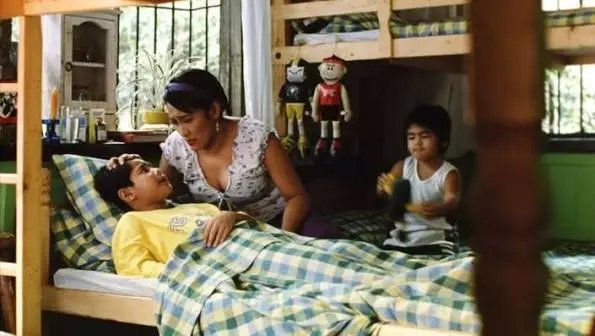
The first installment, “Ang Tanging Ina,” finds the heroine desperately trying to make ends meet for her dozen kids, as her three husbands, one after the other, succumb to ludicrous deaths. With debts racking up, Ina loses the family’s bus company, forcing her to shift between jobs, from construction to becoming a bar entertainer, therefore forging an identity through toil.
In the film’s most emotional moment, Ina delivers a monologue about the taxing ordeal of being a solo, thrice-widowed parent. But just as emotions threaten to erupt further, she pivots to a popular Vilma Santos line from “Anak” (2000), at which point her daughters Tudis (Nikki Valdez) and Por (Heart Evangelista) turn to each other, recognizing the punchline and therefore orienting the audience. The full-bodied physicality with which delas Alas imbues her performance turns such punishingly poignant bits into the stuff of boisterous spectacle. Not to mention that her scenes with the superb Domingo, who plays her best friend Rowena, are an experience to relish through their off-the-charts chemistry.
Through rapid-fire verbal repartee, constant close-ups, and frantic cuts, Deramas treads a careful line between tragedy and comedy, the latter a psychological weapon against the former.
But because Deramas repeats such winking gestures throughout the film while breaking the fourth wall, “Ang Tanging Ina” likewise makes for a metamovie whose humor would surely speak differently to a Filipino spectator than to a non-Filipino one. Its title alone, courtesy of then ABS-CBN president Freddie M. Garcia, is a triple entendre, something foreign viewers may not readily point out, for “Ang Tanging Ina,” meaning “the only mother” in Filipino, is also a play on the Tagalog profanity “putang ina” (“whore mother”) and the colloquial slang “tangeng ina” (“dummy mother”). The target audience could not be any clearer. Deramas also justifies all the cinematic allusions on the story level, establishing the characters as devoted cinephiles who are particularly acquainted with Philippine cinema. The secret to his comedy, then, is referential specificity and how he hones it tenfold.
Deramas was, of course, not the first director to make use of local pop culture in cinema, but he did so with a lexicon and rhythm all his own. In his mix of melodrama and theatricality without resorting to nonsensical mock violence, a staple of Filipino comedy at the time, emerges a kind of queering, an insistence on an elsewhere, to such an extent that he popularized this absurdly campy ethos of processing hardship through hilarity in local cinema. Indeed, “Ang Tanging Ina” is a form-breaking smash.

The use of local pop culture would similarly manifest in “Ang Tanging Ina N’yong Lahat” not just by invoking movie references but by inverting common Filipino maxims and incorporating them in the dialogue. “Ang Tanging Ina N’yong Lahat” likewise allows Deramas to take the cultural commentary up a notch. Whereas the first film is more concerned with the working-class reality of raising 12 kids as a single mother in the early aughts, the 2008 follow-up examines motherhood in the context of electoral politics, proving that Deramas can locate personal truths in a national moment. In doing so, he crafted the best film in the franchise in terms of novelty and profundity.
Released as an official entry to the Metro Manila Film Festival, like much of the franchise, “Ang Tanging Ina N’yong Lahat” sees Ina figuring out how to regain her position as the family’s primary provider, until she and Rowena land a job at the Malacañan Palace, the presidential residence, as chambermaids. There, she learns about an assassination plot that eventually results in her running for president in a snap election and winning by a landslide. The parallels to Filipino politician Cory Aquino’s rise to power during the 1986 People Power Revolution are there for those who choose to see it.
Similarly, Gloria Macapagal Arroyo was then running the country as its second female president. The comedy of errors that follows as Ina attempts to solve the nation’s problems, from traffic congestion to energy crisis, doubles as a critique of the despotic regime and the tumult of living in such hellish times. The political inflection, Mendoza-del Rosario told IndieWire, was a conscious effort. “Because we were repulsed by the government then.”
But beyond this, what “Ang Tanging Ina N’yong Lahat” fundamentally captures is this idea of electoral herd mentality, which arises from the ways we’re all so besotted by political leaders who position themselves as charismatic maternal or paternal figures — the kind of politics delas Alas would adhere to in real life, given her right-wing disposition.
Of the three main installments in the comedy series, “Ang Tanging Ina Mo: Last Na ‘To!” is admittedly the weakest and most consistent with Star Cinema’s formula films. Its raison d’être is pretty predictable from the jump: reunion movie masked as a vision of existential dislocation. After vacating her post as president, Ina is diagnosed with a terminal illness, allowing her to relearn the familial value of sticking together despite the odds.
Most actors in the original film reprise their roles, save for Evangelista and Edu Manzano, who plays one of Ina’s husbands. Even Deramas himself makes an appearance near the film’s coda, in which the director bristles at Ina for interrupting his shooting set. The result is popcorn entertainment with some footage from the previous rollouts thrown in. But while the movie keeps the tonal textures of its predecessors, it lacks their subversive pleasures. Its thematic concerns, for one, just offer the audience more of the same — a classic case of resting on one’s laurels. And yet, luckily, it’s not as chintzy an affair as the crossover sequel.
Though no longer directed by Deramas or co-written by Mendoza-del Rosario, the franchise fatigue would crystallize beyond rescue in “Enteng ng Ina Mo.” It blends the meta elements of “Ang Tanging Ina” and the fantastical bits of “Enteng Kabisote” to tedious ends, completely dulling the magic of the original Deramas trilogy. Terrible visual effects and product placements aside, what makes the crossover feel like a complete overkill is that the interspersed storylines largely rely upon pure coincidence.
Even so, it’s not hard to fathom why the Filipino filmgoing public is so enamored with “Ang Tanging Ina.” In fact, when the pilot picture premiered during a level 3 storm in 2003, the producers were already bracing for it to bomb at the tills, but spectators still found their way to the film, an organic bond that even the greatest publicity work could not easily replicate. Deramas was hardly the first to raise that our families can make or break us, but he extracted such tension with a witty tongue and an inimitable sensibility that was never more potent than in the first two installments of the franchise.
There is a pervasive notion that Star Cinema movies, or mainstream movies for that matter, are never in the business of being smart or deep, partly because they don’t have to and still be commercially rewarded for it. Deramas has proven otherwise — that comedy can be a thinking genre. By sequelizing “Ang Tanging Ina,” he demonstrated what it’s like and what it takes to service and then subvert the limits of mainstream moviemaking. He would go on to direct more big-budget hits, including his legendary team-ups with Filipino superstar Vice Ganda, until his death in early 2016. And when Wenn V. Deramas died, that idiosyncratic mainstream magic died with him.