



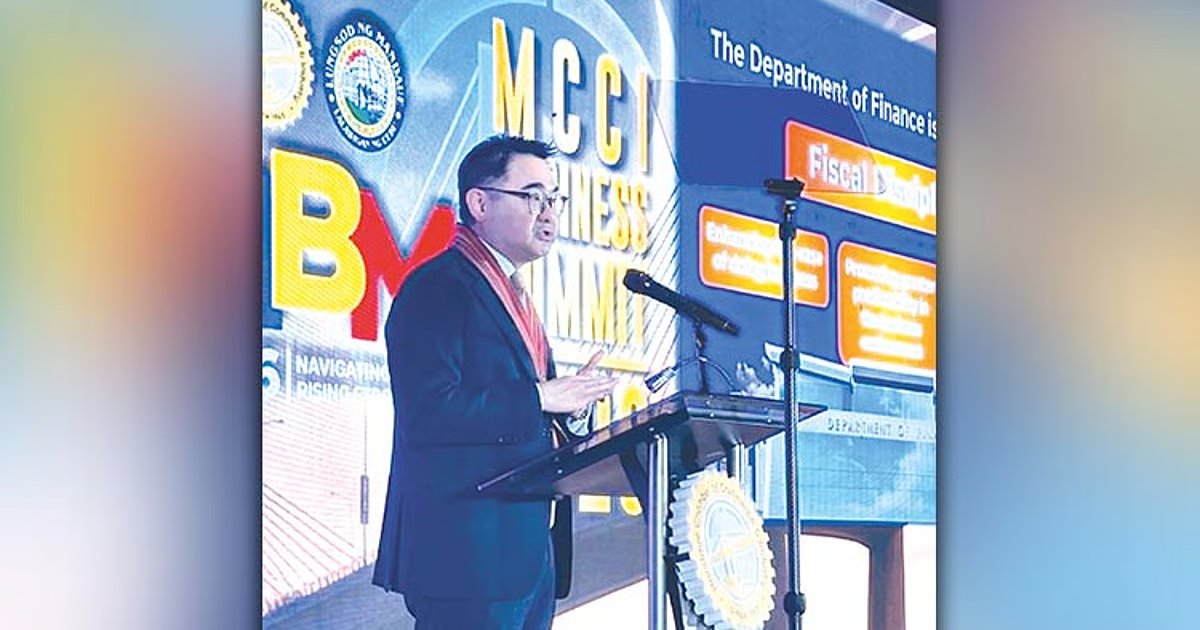
THE Philippine economy is expected to regain its growth momentum in the second half of 2026 as government infrastructure spending resumes, Finance Secretary Frederick Go said.
“I have assurances from the infrastructure implementation agencies, namely Department of Public Works and Highways and Department of Transportation, that the second half of the year will be different and that they will resume their own spending pattern,” Go said during the 2026 Mandaue Business Summit on Thursday, Aug. 13, 2026.
The Philippine economy grew by 2.3 percent in the second quarter of 2026, bringing the first-half gross domestic product (GDP) growth average to 2.6 percent.
Go said slower government spending since the second half of 2025 had weighed on economic growth and continued into the first half of this year.
Go said the government had initially intended to ramp up spending in the first half, but this was disrupted by the global impact of the closure of the Strait of Hormuz amid the Iran conflict, which pushed up oil prices and added to inflationary pressures.
“I think that these twin events are really what prevented us from growing five and a half percent in the last 12 months,” Go said.
Confidence
He expressed confidence that economic growth would return to the five to six percent range in the second half of 2026 and next year.
“My long-term fundamentals remain intact and on solid footing,” Go said, citing strong gross domestic product growth, manageable inflation, a robust labor market and prudent fiscal management.
The Philippine economy has grown by an average of 5.8 percent since the start of the Marcos administration, which Go said remained stronger than global growth.
He acknowledged, however, that growth had slowed over the past 12 months, primarily because of weaker government spending and the external shock from higher oil prices.
Global classification status
Go also highlighted the Philippines’ recent reclassification by the World Bank as an upper-middle-income economy, saying this could help attract more foreign investment and allow the government and businesses to access financing at lower costs.
The country’s general government debt-to-GDP ratio stood at around 58 percent, below the 70 percent threshold used under global standards, he said, giving the Philippines “a lot of fiscal space.”
Go also pointed to continued strength in key growth drivers, including overseas Filipino remittances, business process outsourcing revenues and exports.
Remittances reached $35.6 billion in 2025, up 3.3 percent, while business process management revenues rose 5.3 percent to $40 billion. Total exports increased 8.7 percent to $115 billion, with goods exports growing by about 15 percent in the first seven months of 2026, he said.
Reforms
The government is also banking on reforms to improve the investment climate, including the Create More Act, the new Public-Private Partnership Code, the Investors’ Lease Act allowing leases of up to 99 years, reforms to accelerate right-of-way acquisition, and the Capital Markets Efficiency Promotion Act, which cuts the stock transaction tax to 0.1 percent from 0.6 percent.
Go said these measures are intended to lower the cost and improve the predictability of doing business in the Philippines.
“We in government strive to give you the confidence to invest, succeed, and grow right where you are,” he said. / KOC