


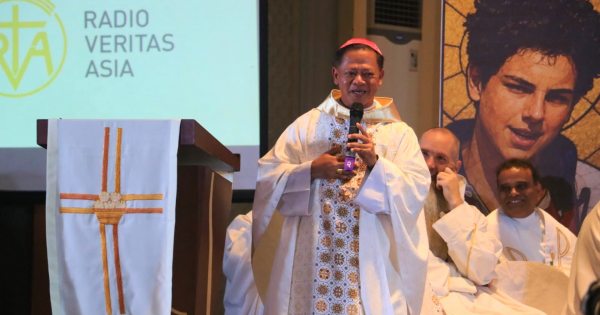
The digital sphere has become a new mission territory for the Church, requiring Christians to bring the Gospel into a rapidly changing environment with discernment, critical thinking and a strong sense of community, Archbishop Rex Andrew Alarcon said.
Archbishop Alarcon made the remarks during the Mass on September 12 at the Pope John Paul II Auditorium in Quezon City, on the second day of the First Asian Catholic Digital Missionary Assembly.
The September 10–13 gathering brings together Catholic digital missionaries, communicators and content creators from across Asia to reflect on the Church’s mission in an increasingly digital culture.
Archbishop Alarcon, chairman of the Catholic Bishops’ Conference of the Philippines Episcopal Commission on Social Communication, described disruption as a significant interruption or disturbance of an established way of doing things.
Throughout history, he said, major developments have disrupted established patterns, citing the voyages of the 16th century, encounters among cultures and languages, and the emergence of new understandings of the world.
“That was a disruption. It changed things globally,” Archbishop Alarcon said.
Today, he said, the new mission territory is no longer primarily the seas or the air but the digital sphere.
“The new mission territory are not the seas, not the air, but the digital sphere,” Archbishop Alarcon said. “Not a parallel world, but a world where we live in. We are already there.”
For the Church, this means digital spaces cannot be treated as something separate from ordinary human life. They have become places where people form opinions, develop relationships, encounter information and search for meaning.
Archbishop Alarcon also warned that technological disruption brings new ethical, philosophical, academic and medical questions, particularly with the rapid development of artificial intelligence.
The challenge, he said, is not to surrender human judgment to technology.
“We are now outsourcing our intelligence,” Archbishop Alarcon said, urging digital missionaries not to “relegate our thinking to the machines.”
He introduced the idea of “critical feeling,” the ability to recognize and examine emotions while allowing reflection and discernment to guide responses.
Social media can quickly provoke anger, fear, outrage, admiration, envy or amusement, he said. Christian digital witnesses therefore need to ask whether their content merely produces an emotional reaction or leads people toward truth, compassion and conversation.